
Ice Fishing for Big Pikes
-
 by Info@bloodycatch.com
- March 8, 2026
- Uncategorized
- 0
Big Pike Fishing in Winter Is Not Just Fishing — It’s Responsibility
Fishing for big pike through the ice is not only about catching fish. It is also about responsibility.
When targeting pike in winter, it is important to understand that this is not just fishing. In most cases we release the fish back, so the way we handle it matters a lot.
Because of that, it is not only the gear or strategy that matters, but also the conditions in which we fish.
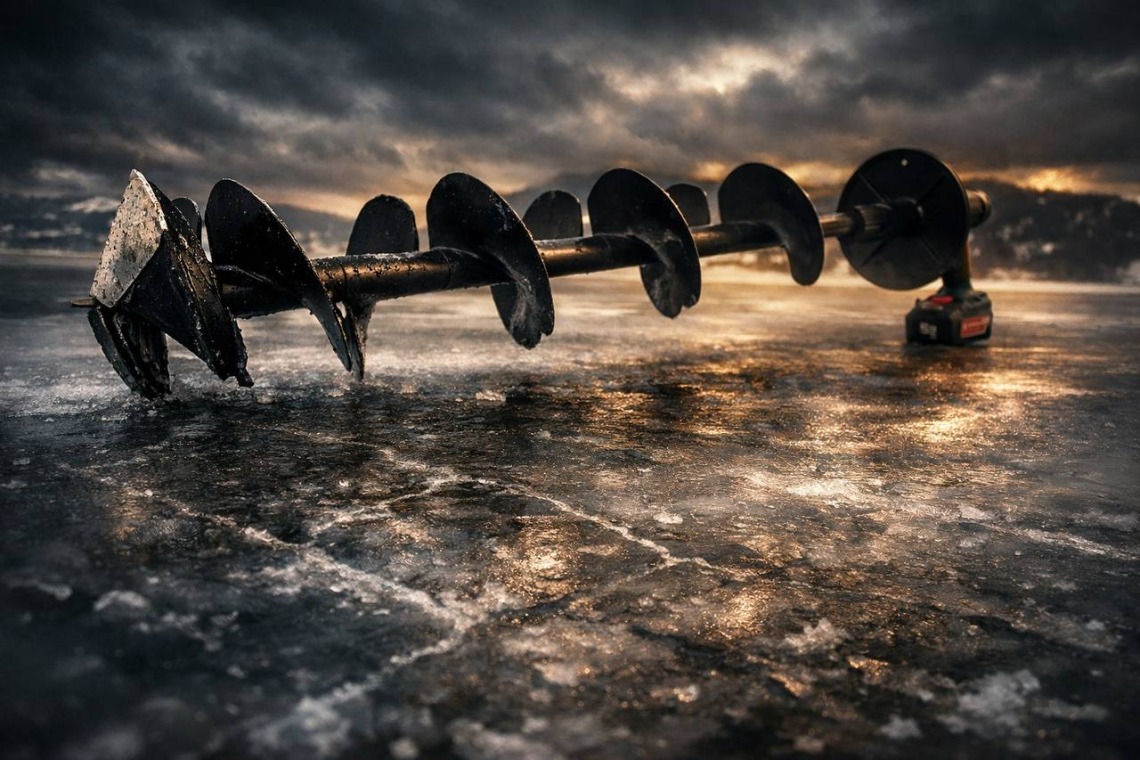
What Ice Auger Diameter Is Needed?
For serious pike fishing, the minimum ice auger diameter should be 200 mm.
Through a 20 cm hole, even a 130 cm pike can pass if its belly is compressed slightly. In practice, however, guiding such a big fish into the hole can be difficult — especially when the ice is thick.
Thick ice creates something like a long tunnel, and you must guide the fish’s head into it at the correct angle.
Large pike often start turning and resisting right under the hole, which makes it difficult to line them up properly.
Because of this, many experienced anglers prefer larger augers in the 220–250 mm range.
A larger hole simply makes landing big fish safer for both the angler and the fish.

Why You Should Use Only One Treble Hook
In most cases, a big pike must be landed by hand when ice fishing. Once the fish reaches the hole, you usually need to reach under the gill plate or carefully control the head to guide it out.
For that reason, it is highly recommended to use only one treble hook.
If a lure has multiple trebles:
-
one hook is usually in the fish
-
another one remains loose
That loose treble can easily hook into your hand, gloves, or clothing while you try to land the fish.
In that situation both the angler and the fish can get seriously injured.
Most of us are not fishing for meat. We fish for the experience.
That means we should always think about safety and fish welfare.
When It Is Better Not to Fish for Pike in Winter
Another very important factor is air temperature.
Many experienced anglers recommend not targeting pike when the temperature is –3°C or colder.
At such temperatures the fish’s protective slime layer freezes very quickly once the fish is out of the water.
This slime layer is extremely important for the fish’s protection.
Even when the temperature is +3°C or –3°C, the fish should be constantly kept wet with water.
If the slime layer is damaged:
-
it is very difficult for the fish to recover
-
the fish becomes vulnerable to disease
-
infections can develop
Another serious issue is the fish’s eyes. In colder temperatures they can freeze very quickly.
In such cases the fish’s life may already be compromised, even if it swims away strongly.
The Fish Swam Away — But Will It Survive?
Many anglers say:
“The pike swam away, so everything is fine.”
But reality is different.
You are not a biologist or a fish doctor who can determine whether the fish is truly fine.
A fish can swim away strongly but still die hours or days later due to stress, slime damage, or frozen eyes.
Always Be Prepared Before Landing the Fish
My advice is simple: be fully prepared before you even pull the fish out of the hole.
You should already know:
-
where you will place the fish
-
how you will measure it
-
how you will keep it wet
-
how you will remove the hook
-
how you will take the photo
Handling a large pike on the ice is not easy.
It is a real challenge and requires fast, well-planned actions.
But this preparation is necessary if we want to protect the fish and the future of our fishing.
Sometimes one bad handling mistake is enough, and that fish may never be caught again — by you or by anyone else.


Join The Discussion